
What is fuel contamination by microorganisms?
Petroleum products are omnipresent in global economic activity. In particular, they are indispensable in transport and heating with the various fuels (kerosene, diesel, heating oil and biofuel).
Biocontamination occurs throughout the production and distribution chain, particularly during storage phases: tanks in oil depots, service station tanks, aircraft tanks, ships, vehicles, etc.
How do fuels become contaminated?
- By the presence of water
Bacteria, yeasts and fungi live in the feet of water in the tanks from natural condensation and concentrate at the interface with the fuel on which they feed.
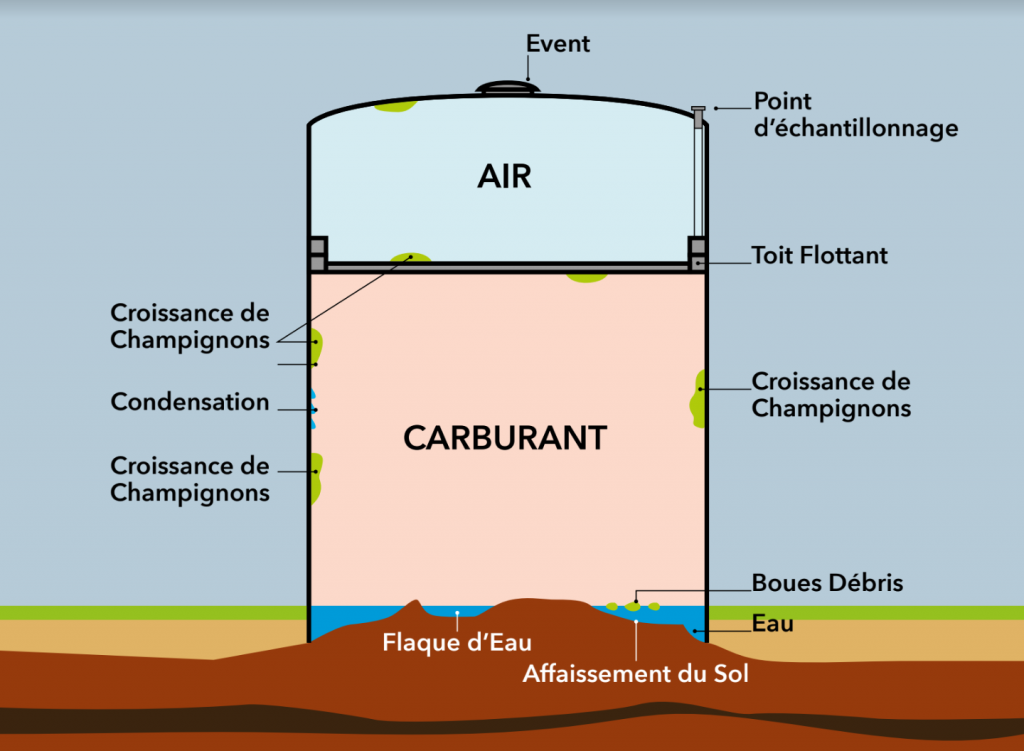
The natural respiration of fuel storage tanks, and rainwater infiltration in the case of floating-roof tanks, contribute to the introduction of a certain amount of water, which usually settles to the bottom of the tanks (see diagram below). This creates a favorable environment for the proliferation of micro-organisms.
" Aerobic hydrocarbonoclast micro-organisms, bacteria and fungi grow at the hydrocarbon-water interface and on the walls at the bottom of the tank. In addition to the formation of fungal mycelium, lipopolysaccharide biosurfactants are produced during bacterial growth on medium- and long-chain alkanes. A biofilm with clogging properties is thus formed. Water purge samples are turbid or emulsified and contain gelatinous masses. Other bacteria thrive in the anoxic environment of the tank bottom water, notablyH2S-producing sulfate-reducingbacteria responsible for corrosion. Gasolines, which contain lighter hydrocarbons, are less prone to surfactant production". (MICROBIOLOGY PETROLIERE, Jean- Paul VANDECASTEELE)
The growth of these micro-organisms can be very rapid. As they grow, they form colonies, skins and debris. The organic matter accumulated in this way, when it migrates into the fuel, can lead to serious operating incidents: clogging of filters, corrosion of circuits by acids or other aggressive substances, deterioration of fuel injection, and sometimes even seizure of the piston-cylinder assembly. Complete obstruction of the fuel supply system is rarely observed, but partial clogging is enough to reduce performance and lead to higher fuel consumption, as engines do not operate at optimum efficiency.
The best way to prevent the development of germs is to drain the water from the tanks frequently.
- Through the presence of diester
Another cause of biodeterioration is the growing use of biofuels, due to rising fossil fuel prices and environmental concerns. Water is introduced into biodiesel during the manufacturing process. It can also be absorbed during storage, as fatty acid methyl esters are much more hydroscopic products than normal diesel. The amount of water in biodiesel affects its calorific value and, above all, the fuel's shelf life, since biodiesel with a high water content is less stable to microorganisms.
What are the consequences of fuel bio-contamination?
The proliferation of these micro-organisms, which is particularly important in the case of middle distillates: diesel, kerosene and domestic fuel oil, causes many disadvantages:
Formation of insoluble products at the hydrocarbon/water interface, leading to clogging of the fuel system (strainers, filters, injectors). The main consequence is the clogging of fuel filters, caused both by micro-organisms and by the matter they produce.
- Appearance of metabolites which promote the emulsification of tank bottom water in the hydrocarbon and can render the product unfit for use. This can lead to loss of fuel flow and damage to the injection system.
FRANCE ORGANO CHIMIQUE designs tests to control and decontaminate these high-risk fuels
To check fuel quality and compliance with specifications, we can carry out MICROBIOLOGICAL ANALYSIS and CHEMICAL ANALYSIS
All you have to do is take fuel samples in sterile vials supplied by us.
We then send you a report with recommendations.
Our experience is at your service.
- The field test : MICROTEST P or theMicrobiological laboratory analysis: IP 385/19 to control fuel quality.
- Treatment product : FUELCIDE D 1.5.
- The search for water and sediment content, complementary analyses to the search for microorganisms and which allows the evolution of the fuel to be monitored over time .