



Description
Easy-to-use test to detect the presence of sulfate-reducing bacteria (SRB).
PROBLEMS
Sulfate-reducing bacteria live in an anaerobic environment and are a source of corrosion and unpleasant odors. They have detrimental effects on metal equipment and infrastructure because they produce hydrogen sulfide (H₂S) by reducing sulfates present in water or aqueous media. The H₂S then reacts with metals to form metal sulfides, accelerating corrosion.
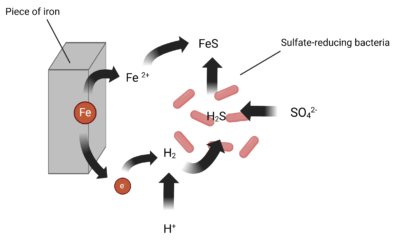
This can lead to the formation of corrosion pits (localized corrosion) on metal surfaces, reducing the mechanical strength of metal structures, the source of potential failures.
Corrosion occurs primarily on pipelines, storage tanks, heat exchangers and oil and gas production equipment.
These problems concern the oil industry, the paper industry, metalworking (cutting fluids), the water treatment industry, the chemical and pharmaceutical industries, power stations, the mining industry, the shipping industry and agriculture (silage systems).
DESCRIPTION
MICROTEST SR detects the presence of live sulfate-reducing bacteria in liquid or viscous media such as sludge. If sulfate-reducing bacteria are present, a black or dark gray coloration begins to appear after 3 to 7 days. It can appear anywhere in the tube, and its intensity depends on the degree of contamination and the bacterial strains.

1 SR Microtest not used
2 SR Microtest contaminated with partial black precipitate
3 SR Microtest contaminated with complete black precipitate
4 SR Microtest with sludge sample
5 SR Microtest contaminated with silage residue sample
Benefits
>> Field test that requires no special knowledge and is easy to read
>> Heterogeneous samples
The Microtest SR can be opened to allow analysis of homogeneous (water) or heterogeneous (sludge, silage straw, water with particles, etc.) aqueous samples.
>> Unchanged salinity
The salinity of the sample inserted into the Microtest SR is not altered because the culture medium is solid. The Microtest SR has been successfully tested on samples from salt ponds in southern France.
>> Other sample characteristics
Like salinity, other sample characteristics (alkalinity, dissolved salts, etc.) are not diluted during insertion into the Microtest SR.
>> Incubation temperature
Microtest SR can withstand high incubation temperatures without exceeding +75°C.
>> Time savings
Since Microtest SR has a richer medium, contamination appears 2 to 10 days (depending on the sample) earlier than the NACE TM0194 standard.
Note
>> Pressure
Microtest SR is not designed to be subjected to pressures other than atmospheric pressure.
They are packaged in 18-tube dishes containing a solid culture medium (agar) specific for sulfate-reducing bacteria. They can be stored at room temperature, protected from light, for 12 months.


The specific agar contains iron sulfate (FeSO4) which is reduced by sulfate-reducing bacteria to sulfide (S2-), which transforms in aqueous medium to hydrogen sulfide (H₂S) and then reacts with ferrous ions to form iron sulfide (FeS) recognizable by its black precipitate.

The test is positive when the black precipitate appears in the agar tube.
Under real-life conditions, the iron molecules come from the steel wall, leading to corrosion and thinning.
USE - Methods
Microtest SR tests for the presence of sulfate-reducing bacteria and can be used in 3 ways: for presence detection, simple enumeration or precise enumeration.
| Methods | ||||
| Code | Name | Precision | Cost | Easy |
| A | Detection | + | + | +++ |
| B | Simple enumeration | ++ | ++ | ++ |
| C | Precise enumeration | +++ | +++ | ++ |
One box of Microtest SR contains :
- 18 tubes containing BSR medium
- 18 labels
- 1 label with QR code to access documentation
The DETECTION method is a yes/no test. A black or dark gray color indicates the presence of sulfate-reducing bacteria.
DENOMBREMENT SIMPLE is a quantification test based on the Most Probable Number (MPN) method.
The DENOMBREMENT PRECIS method is a quantification test based on the Most Probable Number (MPN) method, made more precise by McGrady's probability.
Application procedures for the various methods are described in the Microtest SR Instructions for Use.


Notice
There's no notice yet.